Soakaways Explained: Testing, Sizing and Building Regulations
By Staff4dshire Group · Staff4dshire Groundworks & Utilities ·
Rainwater from roofs, driveways and patios has to go somewhere. Where there is no surface water sewer nearby, or the water company will not accept rainwater into the foul sewer, a soakaway is usually the answer. This guide explains how soakaways work, when you need one, how the ground is tested and sized, where a soakaway can go, and what to do when an old one stops working.
What a soakaway is
A soakaway is an underground chamber that collects surface water and lets it soak gradually into the surrounding ground. It works as a temporary store: during heavy rain it fills quickly, then empties over the following hours as the water drains away into the soil.
There are three common types:
Stone-filled soakaways. The traditional method: a pit filled with clean, single-size stone and wrapped in a geotextile membrane to keep soil out. Simple and robust, but the stone takes up most of the space, so the pit needs to be larger for the same storage.
Geocellular crate soakaways. Lightweight plastic crates wrapped in geotextile. Because the crates are mostly empty space, they hold far more water for their size than stone, which keeps the excavation smaller. This is now the most common choice for extensions, driveways and new builds.
Ring soakaways. Perforated concrete rings set in a stone surround, used where larger volumes need to be stored and where the chamber needs to be accessible for maintenance.
A soakaway is for clean surface water only. Foul water from toilets, sinks and appliances must go to the foul sewer or, off mains drainage, to a septic tank or treatment plant, which is a separate subject with its own rules.
When you need one
Approved Document H of the Building Regulations sets out the order of preference for rainwater. It should go, in priority order, to a soakaway or other infiltration system; where that is not reasonably practicable, to a watercourse; and only where neither is possible, to a sewer. In practice this means a soakaway is the first option to consider whenever new roof or hard surface area is created.
Typical situations where a soakaway is needed include:
A house extension that adds roof area, where the new downpipes cannot be connected to an existing surface water drain
A new build plot, where the drainage design must show where every roof and hard surface drains to
A new driveway or patio that cannot drain onto a lawn or border within the property
A garden or yard that ponds after rain because the ground cannot cope with run-off from nearby surfaces
An old brick or rubble soakaway that has silted up or collapsed and needs replacing
Testing the ground: the percolation test
Not all ground drains well. Before a soakaway is designed, the infiltration rate of the soil should be measured with a percolation test. The usual method follows BRE Digest 365: a trial pit is dug at the proposed location and depth, filled with water, and the time taken for the water level to fall from 75% to 25% full is recorded. The test is normally repeated three times, because the ground drains more slowly once it is wet, and the slowest result is the one used for design.
Sandy and gravelly ground often gives good results. Heavy clay, which is common across parts of Staffordshire and the West Midlands, can drain very slowly, and a high water table can mean the pit never empties properly. If the test fails, a soakaway may not be suitable, and the alternatives include permeable paving, rain gardens, or an attenuation tank that stores the water and releases it slowly to a sewer or watercourse with the owner's consent.
Sizing a soakaway
The size of a soakaway depends on three things: the area that drains to it, the design storm it must cope with, and the infiltration rate found in the percolation test. The calculation balances the volume of water arriving during a storm against the rate at which it can soak away, and the soakaway must have enough storage to hold the difference. It should also empty to at least half full within 24 hours, so it is ready for the next storm.
For a small domestic scheme, building control will usually accept a soakaway designed to BRE Digest 365. For larger developments, planning conditions and the lead local flood authority often ask for drainage designed for a 1 in 100 year storm with an allowance for climate change, supported by calculations from a drainage engineer. An undersized soakaway may work in light rain but overflow in the storms it is meant for, so it is worth getting the sizing right first time.
Where a soakaway can go
Position matters as much as size. Guidance in Approved Document H says a soakaway should not normally be built within 5 metres of a building or a road, and should not be placed where the water could make the ground unstable or wash out fine material. Other points to check include:
Keeping clear of existing foundations, boundaries and neighbouring land
Avoiding underground services, which should be traced and marked before any digging
Avoiding ground that may be contaminated, where infiltration could spread pollution
Leaving access for a silt trap or inspection chamber so the soakaway can be checked and cleaned
On a tight plot, the 5 metre guidance can be difficult to meet. In that case, building control may accept an alternative arrangement, or a different solution such as attenuation may be needed. Always confirm the position with building control before work starts.
Driveways, patios and soakaways
New driveways are one of the most common reasons for a soakaway. In England, replacing or laying more than 5 square metres of hard surface in a front garden needs planning permission unless the surface is permeable or the water is directed to a permeable area or soakaway within the property. Our guide Do I Need Planning Permission for a Driveway in Staffordshire? explains this in more detail.
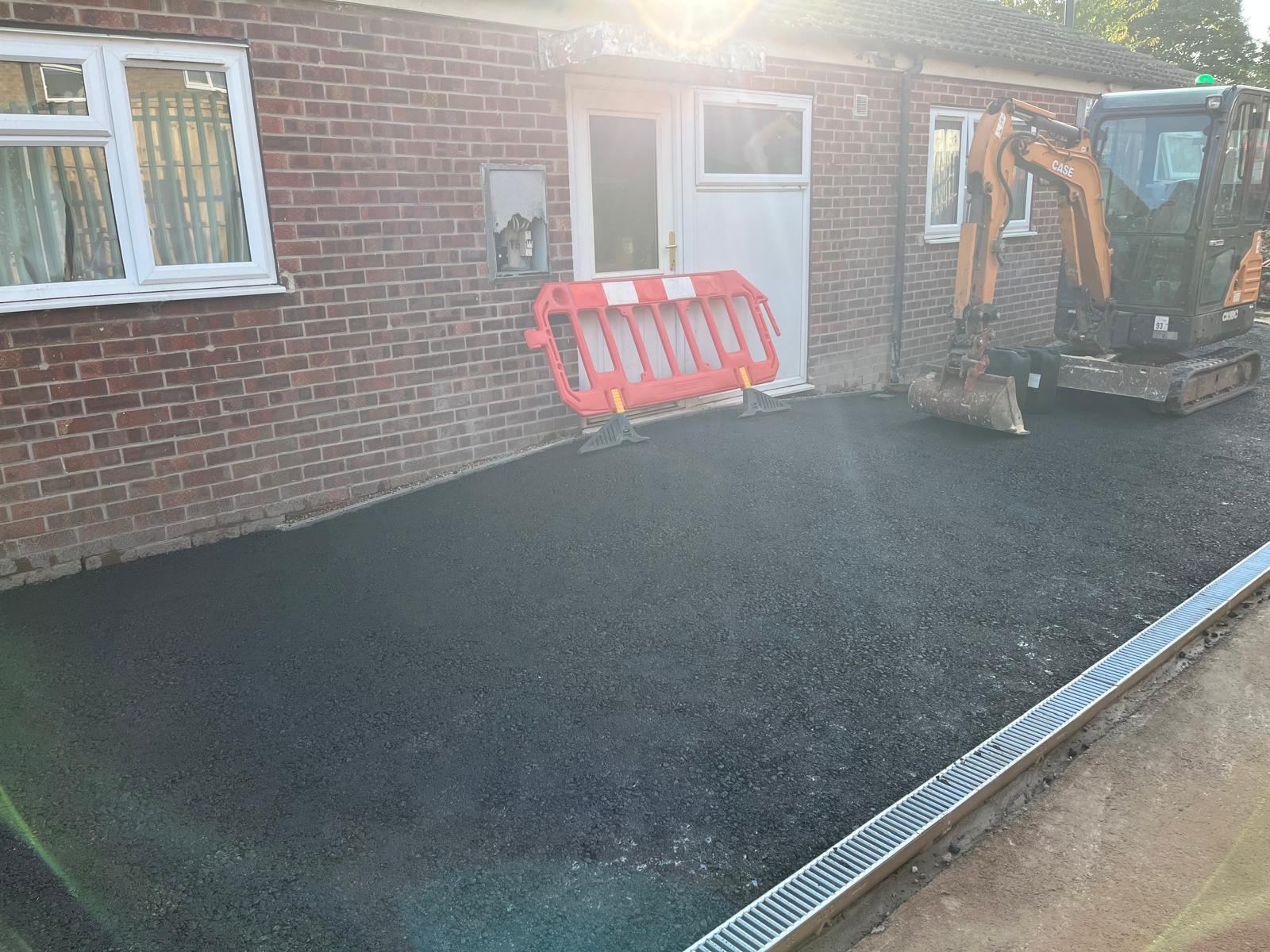
Where a drive is laid in tarmac or standard block paving, a channel drain across the bottom of the slope, or a series of gullies, collects the run-off and carries it through a silt trap to a soakaway. On one sloping garden in Coalbrookdale, for example, Staff4dshire Properties installed ACO channel drainage and a soakaway so the new patios and steps drain properly. The choice between tarmac and block paving also affects how a drive is drained, so it is worth thinking about drainage at the design stage rather than after the surface is down.
How a soakaway is built
A typical crate soakaway installation follows these steps:
Trace and mark underground services, then dig a trial pit and carry out the percolation test
Size the soakaway from the test results and the drained area, and agree the position
Excavate to the required depth, keeping the base level and the sides stable
Line the excavation with geotextile, place the crates or stone, and wrap the geotextile over the top
Connect the inlet pipe through a silt trap or catchpit, so leaves and grit are caught before they reach the soakaway
Backfill, compact and reinstate the surface, whether that is lawn, gravel or a driveway rated for vehicle loads
The silt trap is easy to overlook but makes a big difference. Most soakaways that fail early do so because silt and debris have been allowed to build up inside them, sealing the geotextile and stopping the water from escaping.
Signs of a failing soakaway
Older soakaways, especially brick or rubble pits built decades ago, often fail without anyone noticing until the next heavy storm. Common signs include:
Gullies or channel drains that back up or overflow during rain
Downpipes that overflow at the bottom or gurgle as water struggles to drain
Water pooling in the garden or on the drive long after the rain has stopped
A dip or sinking area in the lawn above the soakaway, which can mean it has collapsed
A CCTV drain survey can confirm whether the problem is a blocked pipe, a silted soakaway or a collapse. A blocked inlet can often be cleared by jetting, but a soakaway that has silted up or collapsed usually needs replacing, and that is a good opportunity to install a properly sized crate system with a silt trap.
Who is responsible for a soakaway?
A soakaway within your property boundary is normally your responsibility as the owner, including keeping it clear and repairing it when it fails. If surface water from your property is causing flooding on neighbouring land or the highway, it is in your interest to resolve it quickly.
Talk to us about drainage and soakaways
Staff4dshire Groundworks & Utilities installs new drainage, soakaways and ACO channel drainage for driveways, patios, extensions and new builds, and surveys and clears existing systems. Because our own plant, groundworks and surfacing teams work together, the soakaway, the drainage runs and the finished surface can be planned and built as one job. We work across Staffordshire, Birmingham and the West Midlands from our base in Rugeley.
Quick checklist
Check whether the new roof or hard surface can drain to an existing surface water system
Carry out a percolation test before designing a soakaway
Size the soakaway for the drained area and the design storm
Keep it at least 5 metres from buildings and roads where possible
Fit a silt trap or catchpit on the inlet
Confirm the design with building control where the work needs approval
Frequently asked questions
Do I need building control approval for a soakaway?
If the soakaway is part of work that needs Building Regulations approval, such as an extension or a new build, the drainage design is checked by building control as part of that application. For a standalone replacement, check with your local building control team before starting.
How deep should a soakaway be?
There is no single depth. It depends on the infiltration rate, the volume needed and the depth of the incoming pipe, and the base must stay above the water table. The percolation test is carried out at the depth the soakaway will be built, so the design reflects the real ground conditions.
Can a soakaway take water from my driveway?
Yes. A channel drain or gullies collect the run-off and carry it through a silt trap to the soakaway. Under a driveway, the crates and cover must be rated for vehicle loads.
What if my ground does not drain?
If the percolation test shows the ground cannot take the water, alternatives include permeable paving, rain gardens, or an attenuation tank that stores the water and releases it slowly to a sewer or watercourse with the owner's consent.
Can foul water go to a soakaway?
No. Soakaways are for clean surface water only. Foul water must go to the foul sewer or, where there is no mains drainage, to a septic tank or treatment plant.
About Staff4dshire Group. Staff4dshire Group is based at Unit 7 & 8 Kimberley Business Park, Rugeley, Staffordshire. Our companies cover building and landscaping (Staff4dshire Properties), roofing (Staff4dshire Roofing Specialists), scaffolding (Staff4dshire Scaffolding), groundworks, drainage and utilities (Staff4dshire Groundworks & Utilities), plant hire (Staff4dshire Plant Hire) and renewables (Margav Energy). We work for homeowners, developers, principal contractors and local authorities across Staffordshire, Birmingham and the West Midlands, and we are a registered supplier with Walsall, Tamworth, Sandwell, Dudley, Birmingham, Telford & Wrekin, Wakefield and Bradford councils.
When a new driveway needs planning permission, how permeable paving and drainage affect it, and when a dropped kerb needs highway consent in Staffordshire.
Tarmac or block paving for your new driveway? Compare looks, durability, drainage and maintenance, with advice from groundworks contractors in Staffordshire.

 Staff4dshire Groundworks & Utilities