 Staff4dshire Groundworks & Utilities
Tarmac vs Block Paving Driveways: Which Is Best?
Tarmac or block paving for your new driveway? Compare looks, durability, drainage and maintenance, with advice from groundworks contractors in Staffordshire.

Getting electricity, water and gas into a new build is one of those jobs that is easy to leave until late and hard to rush. Applications, quotations, design approvals and street works all take time. This guide walks through how utility connections usually work and how to keep them from holding up your build.
The single most useful piece of advice is to start the conversation about utilities as early as possible, ideally when your plans are being finalised. Network operators and water companies need information about your site, the load you need and where the supply will enter the building. Their timescales are outside your control, so the earlier the application goes in, the better.
Each utility has a network owner responsible for the main in the road. New connections can often be delivered by the network operator or, for parts of the work, by an accredited independent connection provider. On the private side of the boundary, a groundworks contractor normally digs the service trenches, lays ducts and prepares the meter positions to the utility's specification.
At Staff4dshire Groundworks & Utilities we specialise in electric, water and gas connections, including new supplies, service trenches and ducting for new builds and developments. We are currently working towards NERS (electricity), WIRS (water) and GIRS (gas) accreditation.
For a new electricity supply, the network operator will need the expected load and the meter position. Ducting is laid in a trench to the right depth, with the correct warning tape and draw cords, so the cable can be pulled through. Where the work involves the public highway, it will be planned under street works rules.
New water connections are made from the water main to a boundary box or meter, then on to the property. The water company will specify the pipe, depth and testing requirements. Supply pipes need enough cover to protect them from frost and damage.
For gas, the gas transporter will design and quote the service, and the meter box position needs agreeing early. Gas service routes are laid with set separation from other services and the correct marker tape. Only suitably qualified people can work on live gas.
On many sites, services can share a trench with the right separation, which saves digging. Coordinating the trench, drainage, foundations and final surfacing in the right order avoids digging up new work. That is where having groundworks, drainage, utilities and surfacing in one team helps.
Foul and surface water drainage are as important as the incoming supplies. A new connection to a public sewer needs the water company's approval. We are currently delivering a new Yorkshire Water sewer connection, alongside drainage clearance, CCTV survey and outfall renewal works, for AMCO in Chapeltown, Sheffield.
Network operators and water companies normally ask for a site location plan, a layout showing where you want the supply to enter each building, and the expected demand, such as the electrical load or the number of properties on a water supply. For gas, they need to know the appliances you plan to use. Having accurate drawings ready saves rounds of questions and speeds up the quote.
Read the quotation carefully. It should be clear which work is done by the network operator, which is contestable and can be done by an accredited contractor, and which is your responsibility on site, such as trenching, ducting and the meter position.
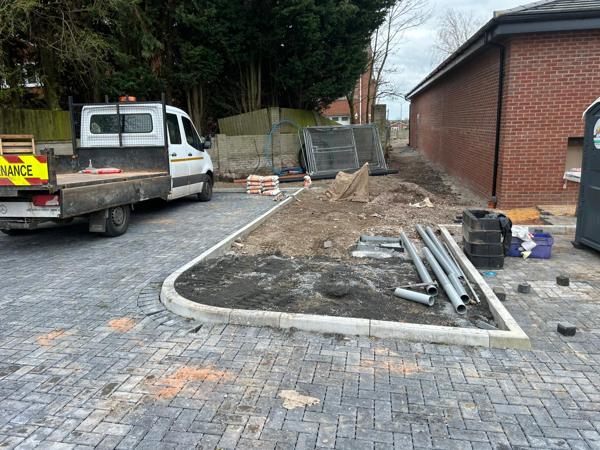
Utility trenches cross the same ground as drainage, driveways and landscaping, so plan the routes early. Duct runs should be recorded and marked so later trades do not dig through them. Getting services in before final surfacing avoids breaking out new tarmac or paving, and agreeing the meter positions with the architect avoids last-minute changes to the elevations.
Staff4dshire Groundworks & Utilities is currently working towards NERS (electricity), WIRS (water) and GIRS (gas) accreditation. Until that is in place, we carry out the civils side of utility work, such as trenching, ducting and reinstatement, alongside the network operator or an accredited provider.
We provide utility trenches, ducting and connections, drainage and groundworks for new builds and developments across Staffordshire, Birmingham and the West Midlands.
Yes. We dig service trenches, lay ducting and prepare for connections for new builds and developments.
We are currently working towards NERS (electricity), WIRS (water) and GIRS (gas) accreditation.
Yes, including new connections to the public sewer, which need the water company's approval.
Staff4dshire Groundworks & UtilitiesTarmac or block paving for your new driveway? Compare looks, durability, drainage and maintenance, with advice from groundworks contractors in Staffordshire.
 Staff4dshire Roofing Specialists
EPDM rubber, GRP fibreglass or torch-on felt? A practical guide to choosing a flat roof for garages, extensions and dormers in Staffordshire.
Staff4dshire Roofing SpecialistsDamp around a chimney breast? How lead flashings, back gutters, pointing and valleys cause most roof leaks, and how roofers in Staffordshire fix them.